|
|
|
Wholesalers: |

|
/ |
|
|
|
|
|
|
|
|
| "Everything is changeable, everything appears and disappears; there is no blissful peace until one passes beyond the agony of life and death." Shakyamuni Buddha (563-483 B.C.) |
|
|
|
|
|
|
|
|
|
|
|
|
|
|
|
|
|
|
|
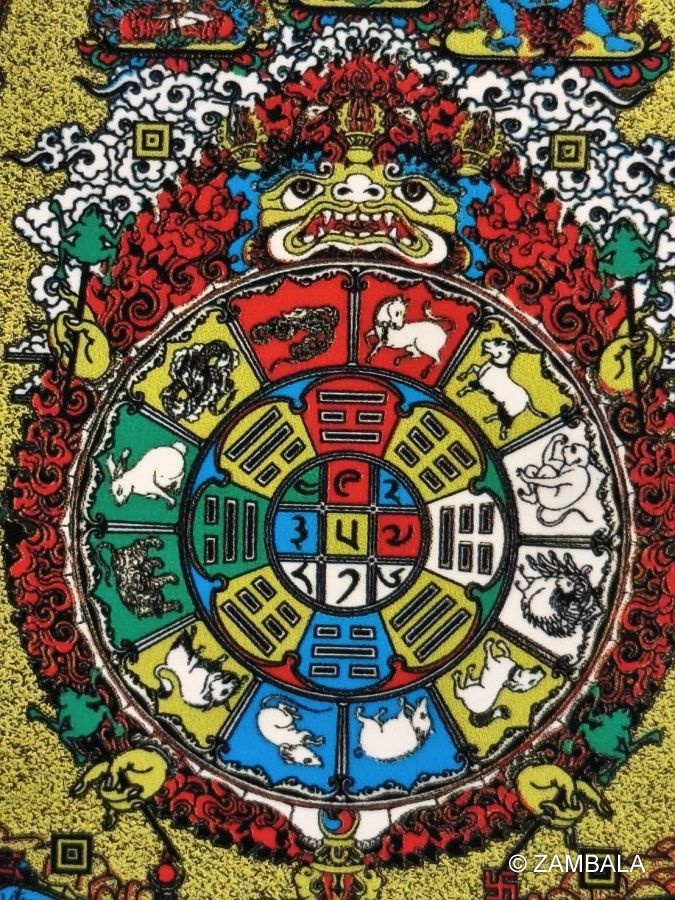
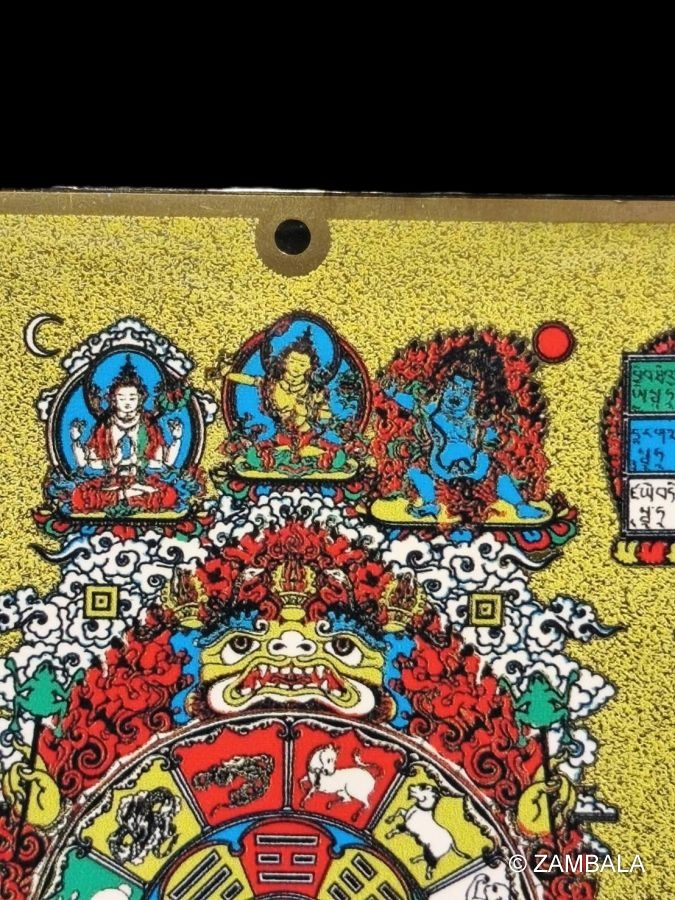
| Protection Mandala Sticker (Promotional price , No discount) |
|
|
|
|
|
Sku#:1400
|
|
《In order to view the wholesale price .
Please Apply to be a wholesalers》
|
|
|
|
|
 |
|
Please contact us to verify availability. 1-626-354-6228
Email: zambalallc@gmail.com
America area customers can view on this website first.
https://FlyingMystics.org/ |
|
|
|
|
|
|
Material: Gold-plated, Buddha image, hard alloy, protective film
Size: 7.6 x 10.2 cm
Description: Overview, origin, and usage of the Nine Palaces Eight Trigrams Mantra Wheel
The "Nine Palaces Eight Trigrams Mantra Wheel" (also known as the "Nine Palaces Eight Trigrams Mantra Wheel Diagram" or "Nine Palaces Eight Trigrams Dharani Mantra Wheel") is an extremely important ritual implement and image for homa (ritual offering), exorcism, and blessing in the Nyingma school (Red Hat sect) of Tibetan Buddhism and some Han Chinese Tantric systems. Its most common form is a circular or octagonal mantra wheel diagram, with "Om Ah Hum" or the six-syllable mantra (Om Mani Padme Hum) at the center, surrounded by the Later Heaven Eight Trigrams and the numbers of the Nine Palaces, and depicted with secret mantras such as the *Buddha Speaks of the Seven Stars of the Big Dipper for Prolonging Life Sutra* or the *Nine Palaces Eight Trigrams Protective Mantra Dharani*, often with 108 or 144 rays of light around the edge.
Origin and Historical Transmission
1. **Source**
- Primarily derived from the *Buddha's Discourse on the Seven Stars of the Big Dipper for Prolonging Life* and the *Great Dharani Sutra Spoken by the Seven Buddhas and Eight Bodhisattvas*, translated by the Tang Dynasty esoteric Buddhist monk Amoghavajra.
- Later, it incorporated the Taoist numerology of the "Nine Palaces and Eight Trigrams" (Luo Shu, Later Heaven Bagua), forming a unique "Buddhist-Taoist fusion."
- During the Song and Yuan dynasties, high-ranking monks of the Nyingma school of Tibetan Buddhism (such as the lineage of Rechung Rinpoche) further esotericized this diagram, adding the three-syllable seed mantra "Om Ah Hum" and numerous deity mantras, making it an important "protective wheel" for the Nyingma school.
2. **Most Famous Transmission Version**
- In the early 20th century, the Nyingma master "Gongga Rinpoche" (Gongga Elder) revived this mantra wheel in Litang, Sichuan, creating the most widely circulated "Gongga Mantra Wheel" to this day. This version features the six-syllable mantra at its center, surrounded by 144 rays of light, and is considered the most efficacious version.
- Another well-known version is the "Ta'er Monastery Nine Palaces Eight Trigrams Mantra Wheel" from Kumbum Monastery in Qinghai, often printed on yellow silk and hung or carried on the person.
Usage (Common Practical and Folk Uses)
1. **Formal Tantric Use (Requires Initiation)**
- The practitioner places the mantra wheel in the center of the mandala, visualizing themselves as Vajrasattva or Avalokiteshvara, using the mantra wheel as a protective wheel, rotating or blessing it.
- Reciting it in conjunction with the *Nine Palaces Eight Trigrams Protective Mandala Dharani* or the *Big Dipper Seven Stars Longevity Mantra* can eliminate nine-star calamities, protect the home, prolong life, and remove obstacles.
- During fire offerings, the mantra wheel image is placed in the four directions of the homa furnace to seal off demons from the four directions.
2. **Simple Folk and Han Chinese Use (No Initiation Required)**
- Printed on paper or silk, the mantra wheel is pasted on the front door, roof beams, bedside, and inside the car to protect the home, ward off evil spirits, and resolve conflicts with malicious people.
- Carrying a small mantra wheel can ensure peace, resolve legal troubles, and ward off illness.
- Placing it under your pillow or at your bedside: It is said to resolve bad luck and illness brought by the "Tai Sui and Nine Stars Calamity".
- Placing it on an altar or Buddhist hall: Enhances the energy field of the mandala, making the worshipped Buddhas and Bodhisattvas more efficacious.
- Cremation or cremation: For the seriously ill or deceased, burn the mantra wheel, mix it with water, and drink it, or place it in the mouth of the deceased; it is said to bring them to a better realm and prolong their life.
Influence on Buddhist Culture (especially Han and Tibetan Buddhism)
1. **A Classic Case of Buddhist-Taoist Integration**
- It represents the most thorough integration of Han Buddhism with the Taoist Nine Palaces and Eight Trigrams. Even many Taoist priests use the "Buddhist version" of the Nine Palaces and Eight Trigrams mantra wheel to draw talismans and ward off evil spirits, making it a living fossil of the exchange between the two religions.
2. **The Tibetan Buddhist Tradition of the "Protector Wheel"**
- In the Nyingma school, the Nine Palaces Eight Trigrams Mantra Wheel is considered one of the Dharma Wheels of "Mamo Protector" (female protector), on par with the "Black Mamo Mantra Wheel."
- Many Tibetan monasteries depict it inside prayer wheels or above monastery gates, making it a common protector totem.
3. **A Symbol of Miraculous Power in Han Chinese Folk Buddhism**
- Since the mid-20th century, especially in Han Chinese societies in Taiwan, Hong Kong, Malaysia, and Singapore, the Nine Palaces Eight Trigrams Mantra Wheel has become one of the most common symbols in Tibetan Buddhism, even more common than the Vajra Knot.
- Many Han Chinese Buddhists, even those who do not practice Tantra, will display one in their homes as a "Buddhist version of the Bagua Mirror," using it for warding off evil spirits and protecting their homes.
4. **Modern Commercialization and Controversy**
- Currently, there are many mass-produced, inexpensive versions on the market, as well as high-priced versions that are claimed to have been "blessed" or "consecrated."
- Authentic Nyingma practitioners emphasize that a truly blessed mantra wheel must be blessed at least 144 times by a qualified master using "Samaya Fire." Ordinary printed copies can only be considered "seeds" with limited efficacy.
In summary, the Nine Palaces Eight Trigrams Mantra Wheel is a product of Tang Dynasty Esoteric Buddhism, the fusion of Buddhism and Taoism in the Song and Yuan Dynasties, and the revival of the Nyingma school in modern times. It combines the beliefs of the Big Dipper, the Eight Trigrams numerology, and Dharani mantras, becoming a cross-cultural protective relic spanning Tibetan Buddhism, Han Buddhism, and even Taoism. It possesses extremely high recognition and a strong foundation of popular belief in East Asian Buddhist culture.
|
|
|
 |
|
|
|
|
|
|
|
|
|
|
|
|
|
|
|
|
© 2026 Zambala inc. All Rights Reserved. No part of this site may be reproduced without our written Permission.
Service Mail: ZambalaLLC@gmail.com
Phone: (626) 289-9787 or 1(888)Zambala (926-2252)
Fax: (626) 289-9719
1904 West Valley Blvd. Alahambra, CA 91803 USA
Unless stated otherwise in content's license. Design By
|
|
|