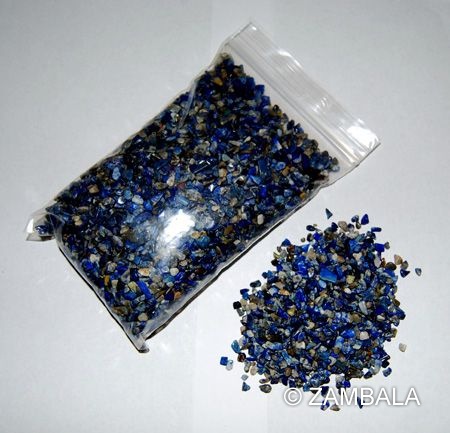
Material: Lapis lazuli, ore, crushed stone
Size: 1 kg
Description: Lapis lazuli is one of the oldest and most precious gemstones in human civilization. Since ancient times, it has been regarded as the "stone of the sky" and the "sacred stone," and holds an extremely high position in Buddhist culture. The following is a complete description from three aspects: **composition**, **characteristics**, and **applications in Buddhist culture**:
1. Composition and Mineralogical Characteristics
- **Main Chemical Components**:
- Lapis lazuli is not a single mineral, but a **rock**, mainly composed of the following minerals:
- **Lazurite**: (Na,Ca)₈(AlSiO₄)₆(SO₄,S,Cl)₂ → Provides a deep blue color (25-40%)
- **Calcite**: White stripes or patches
- **Pyrite**: Golden speckles (referred to as "gold stars" in Buddhism)
- Minor amounts of diopside, sodalite, mica, etc.
- **Color**: The highest quality is **deep blue with a purplish tint**, referred to in Buddhism as "deep blue lapis lazuli" or "deep blue".
- **Origin:** The world's best source is **Badakhshan Province, Afghanistan**, where it has been mined for over 6,000 years. In ancient times, it was introduced to China and Tibet via the Silk Road.
2. Supreme Status in Buddhist Culture
Lapis lazuli is listed as the **first of the Seven Treasures** (or on par with gold) in Buddhism, far surpassing other gemstones. Its symbolic meaning is deeply rooted in Mahayana Buddhism:
(1) Symbolic Color
**Dark blue** is the natal color of **Medicine Buddha** as recorded in the *Medicine Buddha Sutra*:
"In the Eastern Pure Land of Lapis Lazuli, the master Medicine Buddha, has a body of **dark blue**, as bright as lapis lazuli."
Therefore, lapis lazuli is considered the **incarnation stone of Medicine Buddha**, and wearing or offering it can ward off disasters and illnesses, prolong life, and increase blessings.
(2) Records in Buddhist Scriptures
- *The Sutra of the Fundamental Vows and Merits of the Medicine Buddha*: The Medicine Buddha's land is made of lapis lazuli.
- *The Amitabha Sutra*, in its forty-eight vows: Lapis lazuli is one of the seven treasures of the Pure Land.
- *The Heart Sutra*: In the phrase "form is emptiness," lapis lazuli is used as a metaphor for the beauty of "emptiness and form."
- *The Maharatnakuta Sutra*: Lapis lazuli is a "heavenly treasure," worth a thousand times more than gold.
(3) Applications in Tibetan Buddhism (Highest Status)
- **Supreme Offering**:
- The eyes of Buddha statues in the Potala Palace and Jokhang Temple in Lhasa are often inlaid with **Afghan lapis lazuli**.
- The crowns of successive Dalai Lamas are always inlaid with "dark blue gemstone" (the highest grade of lapis lazuli).
- **Thangka Pigment**:
- The most expensive pigment in Tibetan Thangka paintings is **ground lapis lazuli powder** (imported from Afghanistan).
- Used for painting Medicine Buddha, Tara, and sky-blue mandalas, it is called "azure."
- Price: In ancient times, 1 tael of lapis lazuli pigment = 1 tael of gold (even higher today)
- **Pagoda Consecration**:
- When building a pagoda, lapis lazuli fragments are placed in the finial or niche, symbolizing "the blessing of the Medicine Buddha"
(4) Application in Chinese Buddhism
- Medicine Buddha statues are often carved or inlaid with lapis lazuli (Qing Dynasty lapis lazuli Medicine Buddha in the collection of the Palace Museum)
- Among the "Seven Medicine Buddhas" enshrined in temples, lapis lazuli Buddha statues are the most precious
- When reciting the holy name of the Medicine Buddha, holding lapis lazuli prayer beads can increase the merit of "dispelling disasters and prolonging life" a hundredfold
3. Special Applications in Modern Buddhist Culture
| Application Items | Specific Practices | Buddhist Significance |
|----------|----------|----------|
| **Wearing** | 108 Lapis Lazuli Prayer Beads, Bracelet | Medicine Buddha's birth gemstone, dispelling disasters, promoting health, and eliminating karmic obstacles |
| **Offering** | Placing raw ore or carved Buddha in the Buddha Hall | Blessed by Medicine Buddha, Family Peace |
| **Thangka Restoration** | Pigment ground using Afghan lapis lazuli | Revival of traditional craftsmanship (UNESCO Intangible Cultural Heritage) |
| **Medicine Buddha Ceremony** | Presiding monk wears lapis lazuli | Enhances the merit of the ceremony |
4. Rarity Assessment (Tibetan Buddhist Standard)
- ★★★★★ **Dark blue with no white or gold**: Dalai Lama Crown Grade (Extremely Rare)
- ★★★★☆ **Deep blue with purple hues, evenly distributed gold flecks**: Medicine Buddha Image Grade
- ★★★☆☆ **Blue base with white veins and gold dots**: General Thangka Pigment Grade
**Summary**: In Buddhist culture, lapis lazuli is not only a gemstone, but also a symbol of the Medicine Buddha, an embodiment of the Pure Land of Lapis Lazuli, and a sacred object for dispelling calamities and prolonging life. Its turquoise content gives it a unique dark blue color, making it the foremost of the Seven Treasures of Buddhism, especially in Tibetan Buddhism. To this day, in Tibet, pilgrims in Lhasa consider touching the lapis lazuli Buddha eye in the Jokhang Temple the greatest blessing.
If you wish to purchase lapis lazuli for offering or wearing, it is recommended to choose natural old mine material from the Sar-e Sang mine in Afghanistan, with "deep blue with gold flecks" being the best (most in accordance with the name of the Medicine Buddha).