|
|
|
Wholesalers: |

|
/ |
|
|
|
|
|
|
|
|
| "It is better to conquer yourself than to win a thousand battles. Then the victory is yours. It cannot be taken from you, not by angels or by demons, heaven or hell." Shakyamuni Buddha (563-483 B.C.) |
|
|
|
|
|
|
|
|
|
|
|
|
|
|
|
|
|
|
|
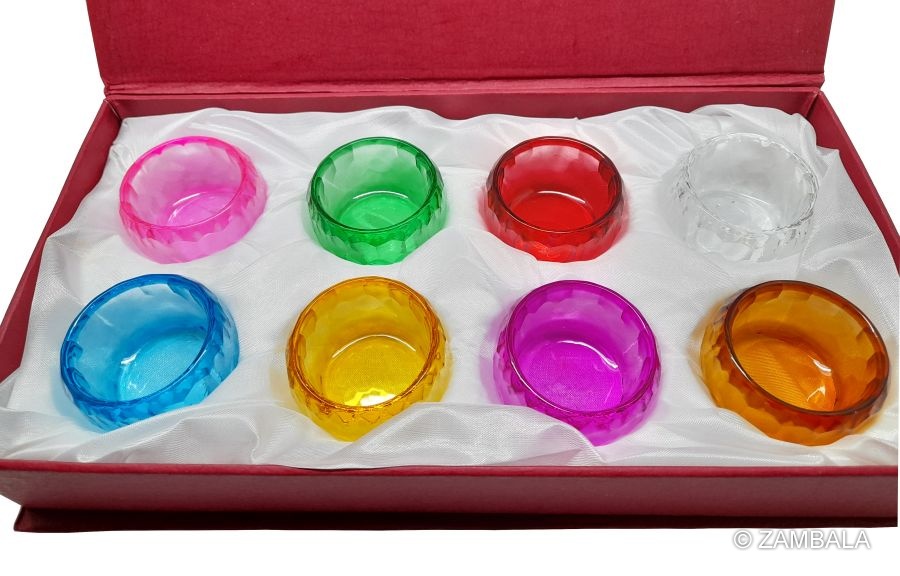
| Diamond cut Crystal Bowl,8pcs a set(M) |
|
|
|
| Bowl |
|
Sku#:2160
|
|
《In order to view the wholesale price .
Please Apply to be a wholesalers》
|
|
|
|
|
 |
|
Please contact us to verify availability. 1-626-354-6228
Email: zambalallc@gmail.com
America area customers can view on this website first.
https://FlyingMystics.org/ |
|
|
|
|
|
|
Material: Crystal. Eight Offering Cups. 3D Carved Pattern
Size: 4.8 cm. Set of eight (random color included)
Description: Crystal Offering Cups are common offering vessels in Buddhist rituals, primarily used to hold offerings such as pure water (or "nectar"), flowers, incense, lamps, and fruits, symbolizing reverence for Buddhas, Bodhisattvas, or Dharma protectors. They are particularly popular in some Tibetan Buddhist (Vatican Tantric) and Han Buddhist temples, commonly found on mandalas, Dharma assemblies, or home shrines. Traditionally, offering cups were made of copper, silver, or ceramic, but modern crystal offering cups (natural or artificial crystals, such as quartz) are widely used due to their transparent and pure appearance, which better symbolizes "pure mind" and "immaculate offering."
I. Composition Analysis
The main material of the crystal offering cup is silicon dioxide (SiO₂), i.e., natural quartz crystal. Its composition and properties are as follows:
| Composition | Chemical Formula | Properties |
|------|--------|------|
| **Silicon Dioxide** | SiO₂ | Purity over 99.9%, colorless and transparent, hardness 7 (Mohs hardness), high temperature resistant and corrosion resistant |
| **Trace Elements** (depending on origin) | Fe, Al, Ti, etc. | May produce varieties such as amethyst and smoky quartz, but colorless and pure crystals are mostly used in offering cups |
- **Natural Crystal**: Sourced from Brazil, Madagascar, Hubei, China, etc., hand-carved and polished.
- **Artificial Crystal**: Synthesized using a high-temperature melting method (verification method), with the same composition but more uniform, commonly found in mass-produced offering cups.
- **Auxiliary Materials**: The bottom or rim of the cup may be inlaid with brass, silver, or lotus patterns to enhance aesthetics and stability.
II. Application in Offering Cups
1. **Containing Pure Water**
- Crystal offering cups are most commonly used to hold "eight offerings" (or seven offerings), symbolizing eight auspicious offerings:
1. Water (for washing feet)
2. Water (for washing hands)
3. Flowers
4. Incense
5. Lamp
6. Perfumed oil
7. Food
8. Music (sound offering)
- The high transparency of crystal allows for a clear view of the Buddha image reflected in the water, enhancing the effect of "visual offering."
2. **Placement Method**
- Usually arranged in sets of seven or eight, from left to right at the front of the offering table.
- The water is changed morning and evening, symbolizing "continuous offering."
3. **Blessing and Purification**
- Offering cups are often purified with saffron water or sandalwood water, or blessed with mantras (such as the Six-Syllable Mantra).
- Crystals are believed to "store energy" and help purify magnetic fields (though there is no scientific evidence, this falls under the realm of belief).
III. Impact on Buddhist Culture
| Aspects | Impact and Significance |
|------|-----------|
| **Symbolic Aspects** | The "colorless transparency" of crystals symbolizes **emptiness** and **pure mind**, aligning with the Heart Sutra's teaching of "form is emptiness." During offerings, believers visualize the crystal as the "Tathagatagarbha," containing immeasurable merit. | | **Aesthetic Enhancement** | Traditional metal offering cups are prone to oxidation, while crystal offering cups remain forever clear, enhancing the solemnity of the mandala and attracting younger believers and the international Buddhist community. | | **Spiritual Aid** | In Tantric "visual offerings," crystals refract light to form rainbow light, symbolizing the "Five Wisdom Tathagatas" or the "Rainbow Body," aiding practitioners in entering samadhi. | | **Cultural Integration** | Modern crystal offering cups, combined with New Age crystal healing concepts, while not orthodox, make Buddhist offerings more accessible and expand their reach. | | **Commercialization Concerns** | High-priced crystal offering cups (often costing thousands of dollars) may deviate from the original meaning of "simple offerings," sparking debate about whether "offerings need to be luxurious." |
Conclusion
Crystal offering cups, with their **purity, transparency, and durability**, perfectly embody the Buddhist spirit of "pure offerings," extending from the traditional seven offerings to modern aesthetics, becoming a bridge connecting the past and present, and integrating faith and life. Whether in temple ceremonies or home shrines, a set of sparkling crystal offering cups is not merely an offering vessel, but also a daily practice of the practitioner's aspiration for "selfless altruism."
> "Offerings are like crystal, clear and undefiled; if the heart is pure in the offering cup, the Buddha's light will naturally shine forth."


|
|
|
 |
|
|
|
|
|
|
|
|
|
|
|
|
|
|
|
|
© 2026 Zambala inc. All Rights Reserved. No part of this site may be reproduced without our written Permission.
Service Mail: ZambalaLLC@gmail.com
Phone: (626) 289-9787 or 1(888)Zambala (926-2252)
Fax: (626) 289-9719
1904 West Valley Blvd. Alahambra, CA 91803 USA
Unless stated otherwise in content's license. Design By
|
|
|