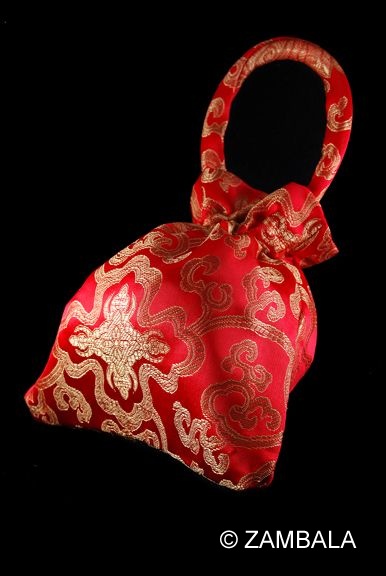
Material: Fabric, Embroidery, Printed, Prayer Bead Bag
Size: 7 x 7.5 cm
Description: Origin, Form, and Usage of Prayer Bead Bags
A prayer bead bag (also known as a "bead bag," "rosary bag," or "prayer pouch") is a cloth bag specifically used to store Buddhist prayer beads (rosaries, Buddhist prayer beads). It is extremely common among Han Chinese Buddhism (China, Japan, Korea, Vietnam) and some Tibetan Buddhists. Its emergence is inseparable from the prayer beads themselves.
Origin
**Its origins can be traced back to the Indian Buddhist period:** Ancient Indian monks braided their hair or strung together tree seeds or bodhi seeds to make prayer beads for chanting mantras, counting breaths, and keeping track of repetitions. At that time, monks often wore prayer beads around their necks or wrists, but carrying them around made them prone to damage or loss. Therefore, simple cloth or leather bags appeared to protect the prayer beads.
- **Evolution after its introduction to China:** After the Tang Dynasty, with the Sinicization of Buddhism, prayer beads became a standard ritual implement for both monks and laypeople. During the Song and Yuan Dynasties, specialized "prayer bead bags" appeared, made from materials ranging from coarse cloth and silk to brocade, often embroidered with auspicious patterns (such as lotus flowers, swastikas, the Eight Auspicious Symbols, and lotus flowers).
**Peak in the Ming and Qing Dynasties:** Exquisite prayer bead bags were popular in both the imperial court and among the common people, becoming symbols of status and faith. The Qing Dynasty imperial workshops even produced prayer bead bags embroidered with golden dragons on yellow satin, exclusively for the emperor and empress dowager.
**Japanese Influence:** Japanese sects such as Jodo, Jodo Shinshu, and Tendai developed prayer bead bags into highly refined items, calling them "juju-bukuro" or "juju-irire." They were often paired with "kesabari-bukuro" (monastic robe bags), made primarily of pure silk, with exquisite embroidery, and adhered to strict sectarian regulations.
Shape and Material
- Common Shapes: Rectangular (can be laid flat), round, gourd-shaped, ruyi-shaped.
- Opening Method: Most are drawstring designs (two ropes pulled tight to close the opening), but there are also buttons, frog buttons, and button-style buttons.
- Material: Monks mostly use plain-colored cotton or coarse silk; laypeople mostly use silk, brocade, brocade, and even embroidery and patchwork.
- Common Patterns: Lotus, swastika, Eight Treasures, Eight Immortals (hidden), lotus flower, scriptures and mantras (such as the Six-Syllable Mantra, Rebirth Mantra), etc.
Usage and Etiquette
1. **Basic Uses**
- To store prayer beads, preventing dust, damage, and loss.
- When reciting mantras, take the prayer beads out of the bag, and put them back after finishing, symbolizing "gathering the mind and body."
2. **Carrying Methods**
- Monks: Usually hung on the left waist (left side of the robe) or placed in a monk's bag (multi-functional cloth bag). - Lay Buddhists: Prayer beads can be worn on the wrist, placed in a handbag, or hung in the rearview mirror of a car (common in modern times).
3. **Important Etiquette Rules (Han Chinese Buddhism)**
- The rosary bag should never be placed in the back pocket of trousers (especially not under the buttocks, as this is considered extremely disrespectful).
- It should not be stepped on or placed on the ground.
- When conversing with others, the rosary beads should not be played with in the hand but should be placed back in the bag.
- The rosary bag of the deceased is usually cremated or placed with the coffin, symbolizing the eternal presence of the Dharma body.
Profound Influence on Buddhism
Although the rosary bag may seem like just an "accessory," it holds multiple profound meanings in Buddhist culture:
1. **A Symbol of Protecting the Dharma**
- The rosary itself is considered a Dharma implement for "purifying body, speech, and mind," and the rosary bag represents the respectful protection of this Dharma implement, embodying the spirit of "Dharma protection."
2. **Reminding Practitioners to Constantly Control the Six Senses**
- Seeing the prayer bead bag reminds one of the beads inside, thus reminding oneself to "recite the Buddha's name, the Dharma, and the Sangha," achieving the psychological suggestion of "seeing the bag as seeing the beads, seeing the beads as seeing the Buddha."
3. **Distinguishing Between Monastic and Lay Identity and Sect**
- Different sects and monasteries have standardized guidelines for the color, pattern, and size of their prayer bead bags. For example:
- Tiantai Sect: mostly brown or purple
- Linji Sect: mostly black
- Pure Land Sect: commonly embroidered with the Amitabha Buddha seed syllable "ki" (Sanskrit "hrih")
- This makes the prayer bead bag one of the symbols of sectarian identity.
4. **Serving as a Medium for Spreading the Dharma**
- Many modern lay practitioners give beautifully crafted prayer bead bags to beginners, containing a string of beads, making it a heartwarming "Buddhist gift" and lowering the barrier to entry.
5. **A Carrier of Culture and Art**
- Prayer bags, embodying traditional crafts such as embroidery, weaving, and dyeing, have become an important part of Chinese Buddhist material culture. The Forbidden City and the Western Qing Tombs preserve a large number of Qing Dynasty court prayer bags, which are of immense cultural value.
In summary, the prayer bag has evolved from a simple "protective cover" into a Buddhist ritual implement that combines practicality, ceremonial function, status symbolism, artistic value, and educational function. It reminds every Buddhist that even the smallest item, when treated with reverence, can become an aid to spiritual practice.