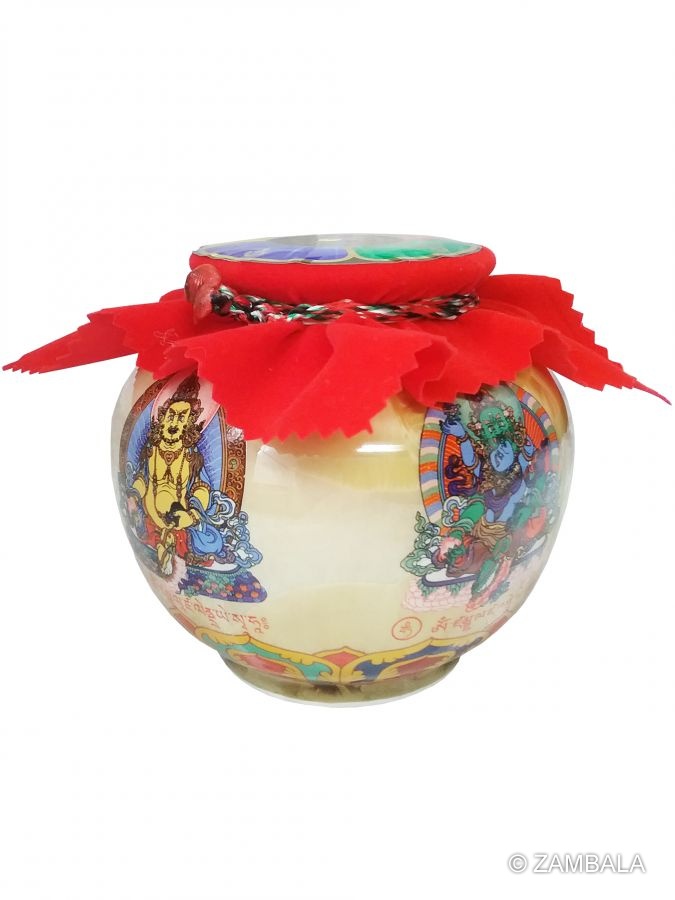
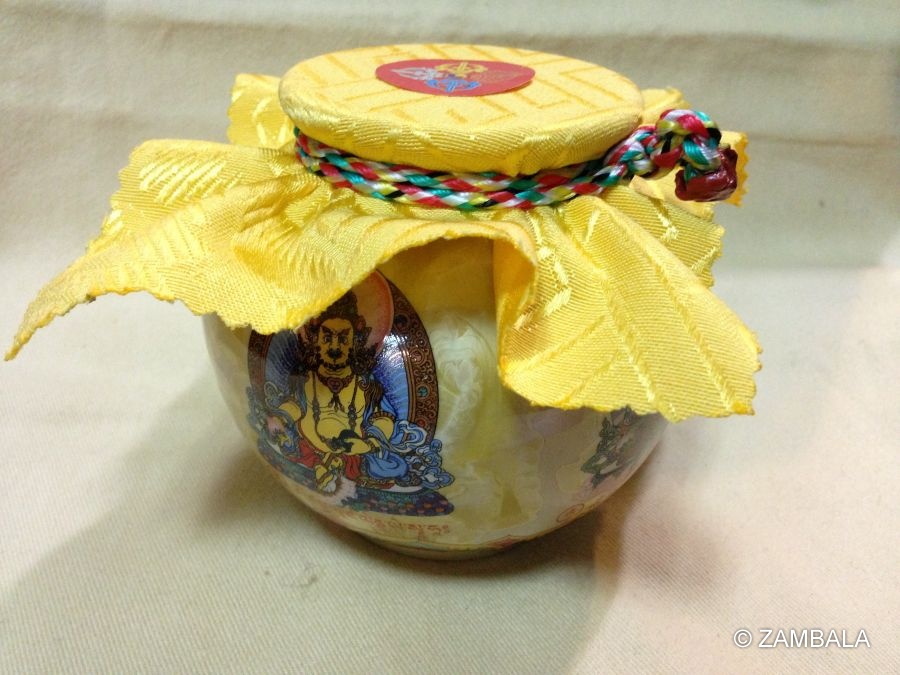
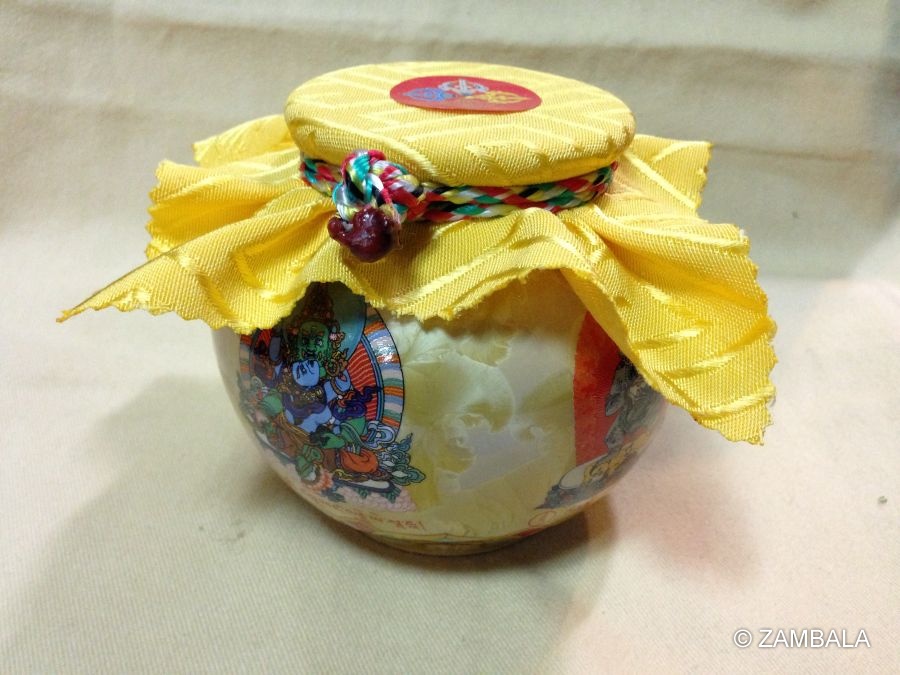
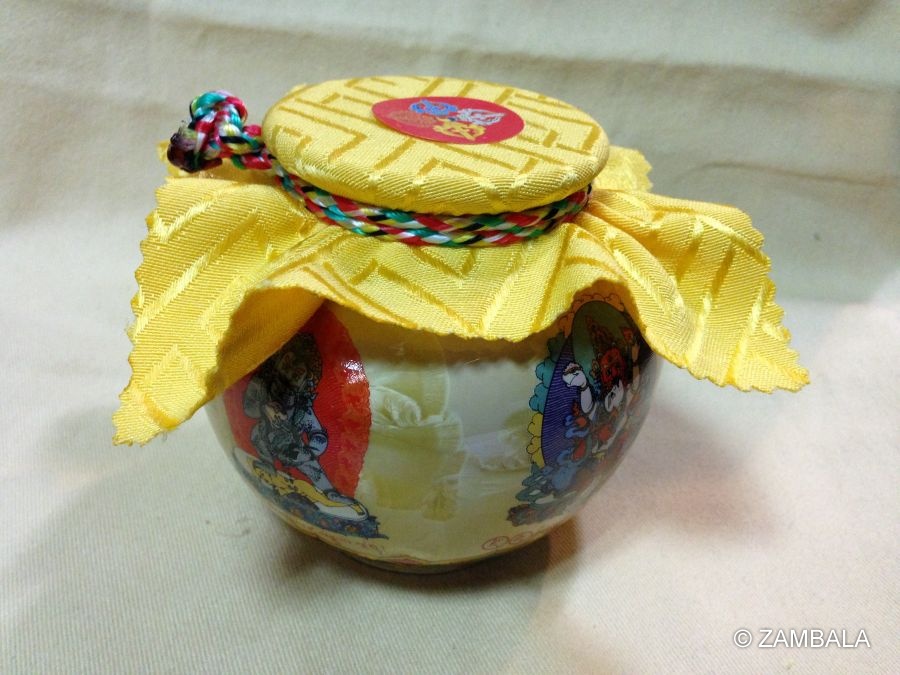
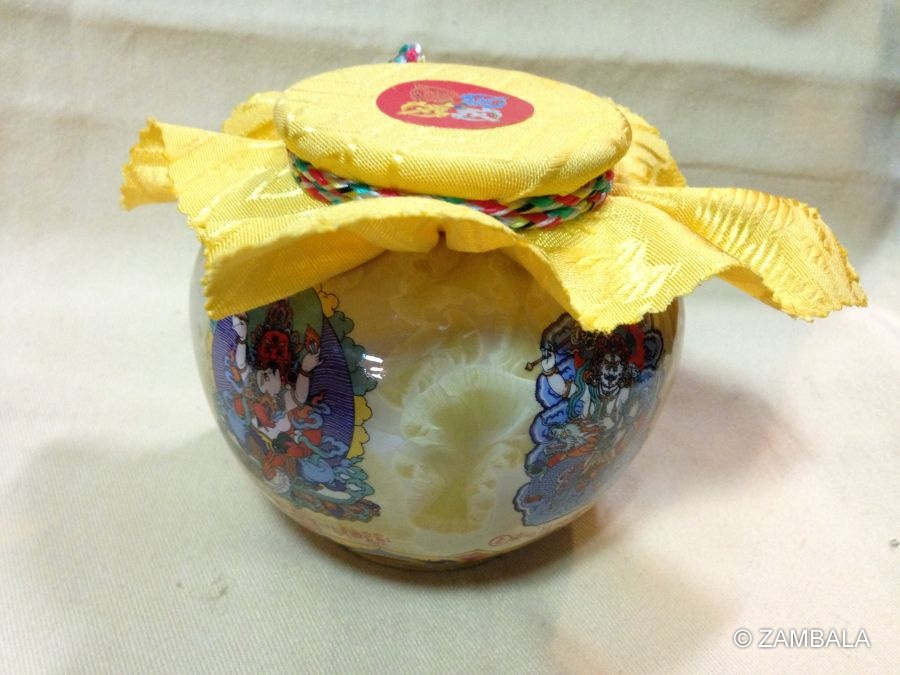
Material: Ceramic (Completed by a professional lama of this association through chanting and consecration)
Dimensions: Maximum diameter approximately 10 cm, height approximately 9.5 cm
Description:
The "Five Gods of Wealth Treasure Vase" primarily appears in Chinese folk beliefs and the Taoist system, and is not a core concept of Tibetan Buddhism. In Chinese-speaking regions (such as Taiwan), many temples dedicated to the God of Wealth (such as Jinshan God of Wealth Temple and Beigang Wude Palace) consecrate and produce "Five Gods of Wealth Treasure Chests" or "Five Gods of Wealth Treasure Vases." These are auspicious objects for attracting wealth, containing talismans, gold paper, treasures, or items blessed by the Five Gods of Wealth. Believers can obtain them through divination blocks and bring them home for worship to replenish their wealth and attract prosperity.
Its origin lies in the Chinese folk belief of the **Five Gods of Wealth**:
- The Five Gods of Wealth refer to the five gods of wealth representing the east, south, west, north, and center. This belief primarily originates from the Ming Dynasty novel *Investiture of the Gods*, with Zhao Gongming (the central God of Wealth) at the head, leading Xiao Sheng (Eastern God of Wealth), Cao Bao (Western God of Wealth), Chen Jiugong (Southern God of Wealth), and Yao Shaosi (Northern God of Wealth).
- The "Five Gods" symbolize the five directions (east, west, south, north, and center), signifying "wealth coming from all directions," ensuring abundant wealth from all directions.
- The treasure vase (or treasure chest) is a ritual implement in Taoist wealth-attracting ceremonies, symbolizing a treasure basin or inexhaustible treasury. It contains talismans of the Five Gods of Wealth, gold ingots, etc., and after being blessed in temple ceremonies, it becomes a wealth-attracting ornament for homes or shops.
This differs from the Tibetan Buddhist system of wealth deities, which is known as the **Five Wealth Deities** or **Five-Colored Wealth Deities** (yellow, white, red, black, and green wealth deities). Originating from the Indian Yaksha god Jambhala, it developed in Tibetan Buddhism into five manifestations of different colors, corresponding to the Five Dhyani Buddhas, and governing the elimination of poverty and the increase of blessings and wisdom.
How to Properly Offer Offerings to the Five Wealth Deities' Treasure Vase
The key to offering offerings to the Five Wealth Deities' Treasure Vase is sincerity, cleanliness, and regular maintenance, the purpose of which is to maintain the flow of wealth energy. The following are common correct methods (based primarily on the customs of Taiwanese wealth deity temples):
1. **Placement Location**:
- Place it in the wealth corner of your home or shop (usually a bright area in the living room, office, or cash register), at a height level with or slightly higher than a person. Avoid placing it in bedrooms, toilets, or dark corners.
- Face the main door or window to allow wealth energy to "enter."
2. **Preparation of Offerings**:
- **Daily or on the 1st/15th of the lunar month**: Three cups of clear tea, fruit (3-5 kinds, in odd quantities, such as oranges, pineapples, bananas, dates, symbolizing good fortune, prosperity, and wealth), and sweets (steamed rice cake, New Year's cake, candy, biscuits; avoid sour, astringent, or hollow foods such as apples and wax apples).
- **Avoid Taboos**: Do not offer pork (because the legend of Zhao Gongming is related to Islam), and do not offer salty foods or foods with negative homophones (such as those related to "poverty" or "loss").
- The three sacrificial animals can be replaced with chicken legs, fish fillets, or dried tofu.
3. **Offering Ceremony**:
- Light three incense sticks and a red candle, and state your name, address, and wishes.
- Regularly (monthly or annually) replenish your wealth treasury: burn joss paper for the Five Gods of Wealth, replenish the treasury, or return to the temple to participate in a Dharma assembly.
- If the items in the treasure vase are damaged, they can be returned to the temple for replacement or blessed again.
4. **Daily Precautions**:
- Keep it clean for good fortune.
- Sincerity is key; after making offerings, work hard. Both earned and windfall income require good deeds and accumulating merit.
**Meanings and Influences in Tibetan Buddhism**
While Tibetan Buddhism does not have a specific ritual implement called the "Five Wealth Gods' Vase," it does have similar **vase (Kalasha)** symbols and a **Five Wealth Gods** (Five Colored Wealth Gods) system:
- **Meaning of the Vase:** In Tibetan Buddhism, the vase is one of the Eight Auspicious Symbols, symbolizing inexhaustible wealth, merit, longevity, and the wellspring of wisdom. It is commonly found in offering rituals or mandalas, filled with nectar, representing reverence for the Dharma and abundant resources.
- **The Five Wealth Gods:** Originating from Jampalak, originally a single deity, later divided into five: Yellow (an emanation of Ratnasambhava, the chief deity, increasing blessings and wisdom), White (an emanation of Avalokiteshvara, removing poverty and illness), Red (an emanation of Amitabha, attracting benefactors), Black (an emanation of Akshobhya, subduing enemies and obstacles), and Green (an emanation of Amoghasiddhi, fulfilling wishes), corresponding to the five directions and five elements.
- Meaning: Emphasizing not only material wealth but also spiritual resources (merit and wisdom), eliminating poverty and suffering, and increasing good karma. Practice must be based on compassion; giving precedes receiving.
- Influence: Widely worshipped by major schools of Tibetan Buddhism (such as Nyingma, Sakya, and Gelug), especially in Taiwan where dedicated temples exist (such as the Taichung Baojilin Tibetan Five Wealth Gods Temple). It strengthens the practical aspect of Tibetan Buddhism, helping sentient beings accumulate merit and purify obstacles in worldly affairs, while reminding them of the impermanence of wealth and the need for Bodhicitta (the aspiration to attain Buddhahood for the benefit of all beings).
In short, the "Five Wealth Gods Treasure Vase" is primarily a wealth-attracting ritual implement used in Chinese Taoism/folk religion, while the Tibetan Buddhist wealth god system emphasizes inner blessings and wisdom. If you are referring to Tibetan wealth god offerings, you can refer to chanting mantras, lighting butter lamps, or offering nectar from the vase. For more specific rituals or images, please provide further details!
Note: This item is to be completely dedicated and sealed closed. It should not be opened. If opened, the dedication of the vase is lost and its magnetic properties are dispelled.