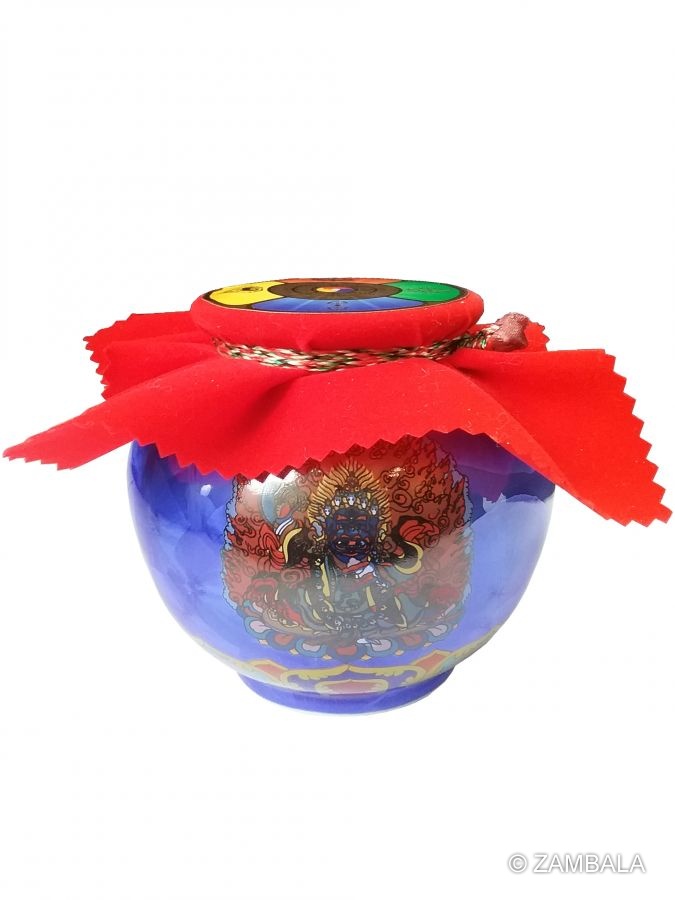
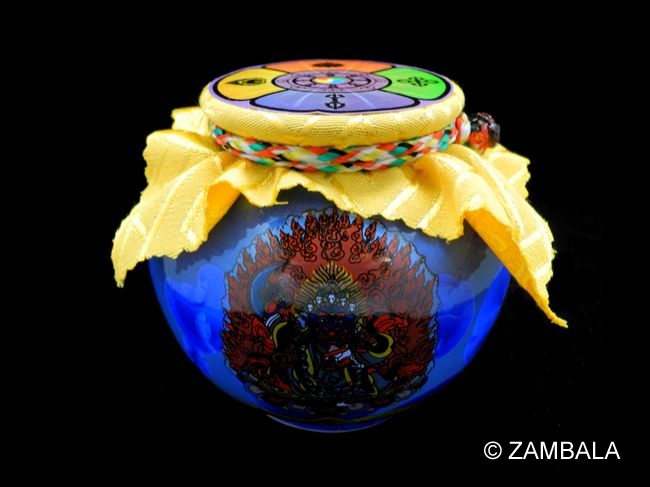
Material: Ceramic (Completed by a professional lama of this association through chanting and consecration)
Dimensions: Maximum diameter approximately 10 cm, height approximately 9.5 cm
Description:
Mahakala (Tibetan: Gonpo Napochenpo, Sanskrit: Mahākāla), also known as the Two-Armed Great Black Deity, is one of the most important guardian deities in Tibetan Buddhism. He is depicted with one face and two arms, a dark blue-black body, short and stout, with three wide-open eyes, red hair standing on end, and wearing a five-skull crown. His left hand holds a kapala bowl (skull bowl) filled with blood, while his right hand holds a curved knife (axe). A short club is placed horizontally between his arms, and he stands on his feet, trampling on a corpse symbolizing demonic obstacles. Flames surround his body.
His origins can be traced back to ancient India, where he was originally an incarnation of Shiva (Maheshvara) in Brahmanism (Hinduism), later absorbed into the Vajrayana Buddhism and transformed into a guardian deity. Tibetan Buddhism considers the two-armed Mahakala to be the wrathful manifestation of Samantabhadra (or Vajradhara), symbolizing the subjugation of inner and outer obstacles with fierce compassion. He is particularly the exclusive protector of the Karma Kagyu school (Black Hat lineage), with successive Karmapas (Karmapa) having a deep karmic connection with him and vowing to protect the school's Dharma propagation activities. Other schools (such as the Gelug school, which prefers the six-armed form, and the Sakya school, which has four arms) also commonly venerate different manifestations of Mahakala, but the two-armed form is most revered in the Kagyu school.
Regarding the "treasure vase" (Tibetan: Yangbum/Terbum, meaning treasure vase or hidden treasure vase), this is an ancient traditional ritual implement in Tibetan Buddhism. It is not exclusive to the two-armed Mahakala but is often associated with the white six-armed form of Mahakala (White Mahakala). White Mahakala is a protector of wealth. The vase contains jewels, medicines, grains, sacred objects, a mandala wheel, and a small image of White Mahakala. After strict ritual empowerment, it is believed to attract abundance, balance elements, and increase merit. The vase tradition originated with great Indian masters and was established in Tibet by Guru Padmasambhava and others. Many monasteries (such as the Gelug and Shangpa Kagyu schools) place vases in mandalas or homes to pray for wealth, health, and harmony.
Two-armed Mahakala does not have a separate tradition of a dedicated "two-armed Mahakala vase." It may be an extension of specific lineages or folk offerings (such as using vases for protector offerings), or a form of confusion with wealth deities. However, broadly speaking, Mahakala protector offerings often involve vase-like ritual implements to symbolize abundant resources.
How to Offer Correctly
Offering to Mahakala (including the two-armed form) requires utmost respect, as he is a powerful protector; improper offerings may cause obstacles. Basic Principles:
1. **Mandala Setup**: Place it in a clean, high place (such as a Buddhist altar), facing inwards (not towards the door). A two-armed Mahakala thangka or image can be placed there, with offerings placed in front.
2. **Daily Offerings**:
- **Toma Offering**: Primarily on the 29th of each Tibetan month (Protector's Day), offer red toma (made with flour, ghee, etc., dyed red to symbolize blood and flesh), accompanied by the "five nectars" (tea, wine, milk, meat, etc.) or sensory offerings. Recite the mantra: **Om Mahakala Hum Phat Svaha**.
- **Smoke Offering, Tsok Offering**: Burn incense (Tibetan incense) or offer toma, praying to the Dharma protectors to remove obstacles.
- **If involving a vase**: If offering a vase related to White Mahakala, place it on the altar, and re-initiate or offer (water, incense, flowers, etc.) annually. Do not open the package, do not place it on the ground, and offer the eight offerings (water, flowers, incense, lamps, etc.) regularly.
3. **Precautions**:
- You must have received empowerment or permission from a guru before practicing the ritual (such as the "Simplified Daily Practice of Two-Armed Mahakala").
- When making offerings, generate Bodhicitta, praying to the Dharma protectors to safeguard the Dharma, remove obstacles, and increase blessings.
- Vegetarians may use symbolic offerings instead, avoiding real meat and alcohol.
- At the end of the year or the new year, regularly perform Mahakala rituals to remove obstacles from the old year and welcome auspiciousness in the new year.
Meaning and Influence in Tibetan Buddhism
**Meaning**:
- **Wrathful Appearance**: Outwardly fierce (black body, blood bowl, flames), inwardly filled with great compassion, symbolizing the burning of greed, anger, and ignorance with the fierce fire of wisdom, severing ego and demonic obstacles. Black represents the unchanging Dharma nature, short stature represents humility, three eyes represent understanding the three times, and the five skull crown represents transforming the five poisons into the five wisdoms.
- **Essence of the Protector:** As the root of the "Three Roots" (Guru, Yidam, and Protector), Mahakala is responsible for achieving goals, removing obstacles, and increasing benefits. It particularly symbolizes the swift subjugation of stubborn beings in the degenerate age, protecting practitioners from external demons (obstacles) and internal demons (afflictions).
- **Wealth and Abundance:** Although the two-armed form leans towards activity-based protection, Mahakala as a whole (especially the white form) also carries the connotation of a wealth deity. The vase symbolizes both inexhaustible inner merit and wealth, and external material abundance.
**Influence:**
- Mahakala is the chief protector revered by all four major schools of Tibetan Buddhism (Nyingma, Kagyu, Sakya, and Gelug). Monasteries invariably have protector shrines dedicated to him.
- It has the deepest influence in the Karma Kagyu school, serving as the unique protector of successive Dharma Kings, contributing to the flourishing of the Dharma.
- It is widely used in obstacle-removal ceremonies, wealth prayers, and monastery protection, influencing Tibetan culture (such as year-end protector rituals).
- Modern extensions include healing the land and balancing the environment (the vase is buried in the ground), praying for peace and abundance.
For deeper practice, it is recommended to seek guidance from a qualified master to receive the correct lineage and blessings. May all be auspicious and fulfilling!
Note: This item is completely dedicated and sealed. It should not be opened. If opened, the dedication of the vase is lost and its magnetic properties are dispelled.