|
|
|
Wholesalers: |

|
/ |
|
|
|
|
|
|
|
|
| "Wisdom, compassion, and courage are the three universally recognized moral qualities of men." Confucius (Chinas most famous teacher, philosopher, and political theorist, 551-479 BC) |
|
|
|
|
|
|
|
|
|
|
|
|
|
|
|
|
|
|
|
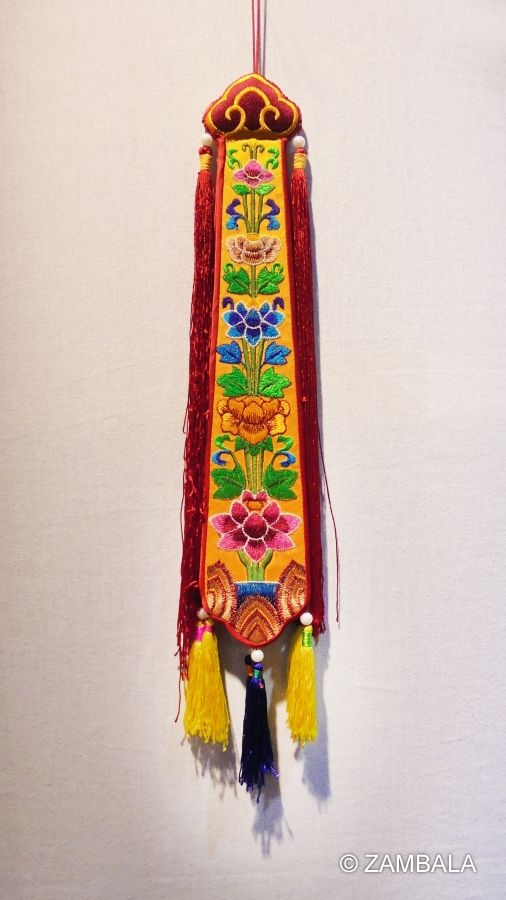
| Damaru Chopen emb. Flower |
|
|
|
|
|
Sku#:3229
|
|
《In order to view the wholesale price .
Please Apply to be a wholesalers》
|
|
|
|
|
 |
|
Please contact us to verify availability. 1-626-354-6228
Email: zambalallc@gmail.com
America area customers can view on this website first.
https://FlyingMystics.org/ |
|
|
|
|
|
|
Material: Fabric, Embroidery, Tassels, Hand Drum
Size: 55 cm Total Length
Description: In Tibetan Buddhist ceremonies and rituals, a set of brightly colored silk tassels (usually five colors or a combination of white, red, and blue) are tied to the back of the vajra and the human skin hand drum (Damaru, Tibetan). This is called "rgyan chal" or "dar rgyas" in Tibetan, often translated into Chinese as "ribbon," "tassel," "colorful," or "victory ribbon." These tassels are not merely decorative; they have profound symbolic meaning, ritual function, and historical origin.
I. Symbolic Meaning
1. **Represents the "Five Wisdom Buddhas" or "Five Buddha Crowns"**
The most common feature is the five-colored tassels (white, blue, red, green, and yellow), corresponding to the five wisdoms of the Five Dhyani Buddhas (Dharmakaya Wisdom, Great Mirror Wisdom, Equality Wisdom, Discriminating Wisdom, and Accomplishing Wisdom). Tying five colors to the drum's tail symbolizes that the hand drum itself incorporates the blessings of the Five Buddhas.
2. **Symbolizes the "Victory Banner" and "Victory"**
"Dargyas" means "expansion of the victory banner," representing the subjugation of demons and the overcoming of obstacles. Especially in tantras, the tassels fluttering when the drum is shaken symbolize the Buddha's teachings and blessings spreading in all directions, defeating and dispersing the demonic forces.
3. **Symbol of the Union of Man and Woman**
Dharmaru itself is a symbol of the union of "method" (male, represented by the vajra hanging from the drum handle) and "wisdom" (female, represented by the drum body often made of skulls depicting men and women intertwined). The tassels fluttering outwards from the drum's tail represent the "great bliss and wisdom" arising from union, radiating outwards to benefit all beings.
4. **The Special Meaning of White Tassels**
Many old drums of the Nyingma and Kagyu schools are often tied with long white ribbons, called "White Hadda Victory Banners," symbolizing the wisdom of Manjushri or the swift blessings of Dakinis (white is often associated with Dakinis). Some traditions believe that the white tassels imitate the hair of Dakinis or the mane of lions.
II. Ritual Functions
1. **Enhancing the Propagation and Blessing Power of Sound**
Tantric rituals believe that when the drum is shaken, the fluttering tassels can carry the mantra blessings of the drum sound further, even to pure lands or the void, summoning Buddhas, Dharma protectors, Dakinis, and Heroic Fathers and Mothers to come quickly.
2. **Exorcism and Purification**
The trajectory traced by the tassels in the air is seen as the Vajra boundary line drawn by a Vajrakilaya or Vajra pestle, breaking through the space of demons and possessing a very strong "subduing" effect. Therefore, during the "Ranghui" (exorcism and liberation) ceremony, monks vigorously swing the tassels at the end of the drum.
3. **Indicating Lineage and Level**
Different lineages have different ways of binding tassels, in terms of length, color, and number:
- Nyingma: Often adorned with long, flowing white or five-colored tassels.
- Sakya: Mostly uses alternating red and white tassels, which are shorter.
- Gelug: More standardized, commonly using red, blue, and white.
- The drum used for high-level initiations in the Anuttarayoga Tantra has particularly long and numerous tassels, sometimes even adorned with small bells.
III. Historical Origins
1. **Originating from the Indian Tantric "Victory Banner" (Dhavja)**
The earliest origins can be traced back to the Tantric tradition of India from the 8th to 12th centuries. Indian yogis and accomplished masters (Mahasidi) would bind victory banners to ritual implements such as hand drums and bone horns during practice, signifying "attainment of accomplishment and the shunning of demons." In Tibet, it is called "Jeda" (rgyal mtshan, victory banner).
2. **The Legend of Guru Rinpoche and Dakinis**
According to Nyingma tradition, in the 8th century, when Guru Rinpoche subdued heretics at Nalanda University in India, the tassels on his hand drum transformed into vajra flames, subduing all the heretics. This decoration has been retained on almost all Tibetan hand drums ever since.
3. **The Connection with the Battle Flag of Shambhala, the "Heaven on Earth"**
In the Kalachakra tradition, the style of the tassels is believed to originate from the battle flag of the Shambhala kingdom, symbolizing the ultimate victory of the "Kalachakra War" over the invaders (barbarians). Therefore, the tassels on the ritual implements of the Kalachakra mandala are particularly ornate and long.
In summary, the cloth tassels at the back of the Tibetan hand drum are far more than just aesthetics; they are an extremely important ritual component embodying multiple esoteric meanings, including "the blessings of the five wisdoms, the victory over demons, the radiation of great bliss and wisdom, and the invocation of dakinis." When you see hundreds or thousands of hand drums shaking simultaneously and thousands of colorful ribbons flying in the air during a Dharma assembly, that is the most spectacular display of the Tibetan Buddhist "Vajra Dance of Sound and Light"—sound subdues demons, and light (tassels) shines everywhere.
|
|
|
 |
|
|
|
|
|
|
|
|
|
|
|
|
|
|
|
|
© 2026 Zambala inc. All Rights Reserved. No part of this site may be reproduced without our written Permission.
Service Mail: ZambalaLLC@gmail.com
Phone: (626) 289-9787 or 1(888)Zambala (926-2252)
Fax: (626) 289-9719
1904 West Valley Blvd. Alahambra, CA 91803 USA
Unless stated otherwise in content's license. Design By
|
|
|