|
|
|
Wholesalers: |

|
/ |
|
|
|
|
|
|
|
|
| "Endurance is one of the most difficult disciplines, but it is to the one who endures that the final victory comes." Shakyamuni Buddha (563-483 B.C.) |
|
|
|
|
|
|
|
|
|
|
|
|
|
|
|
|
|
|
|
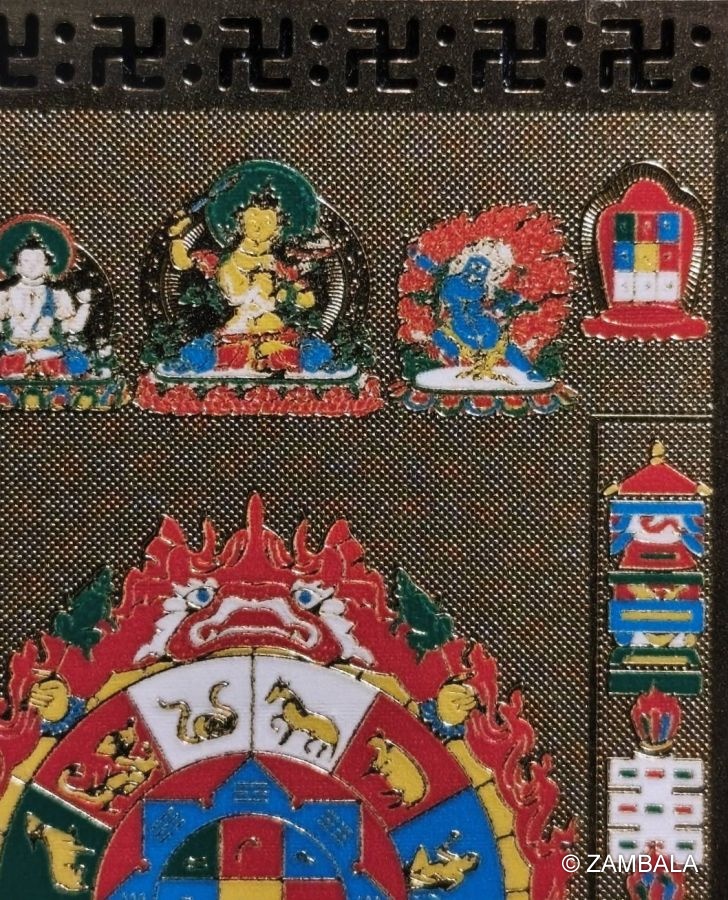
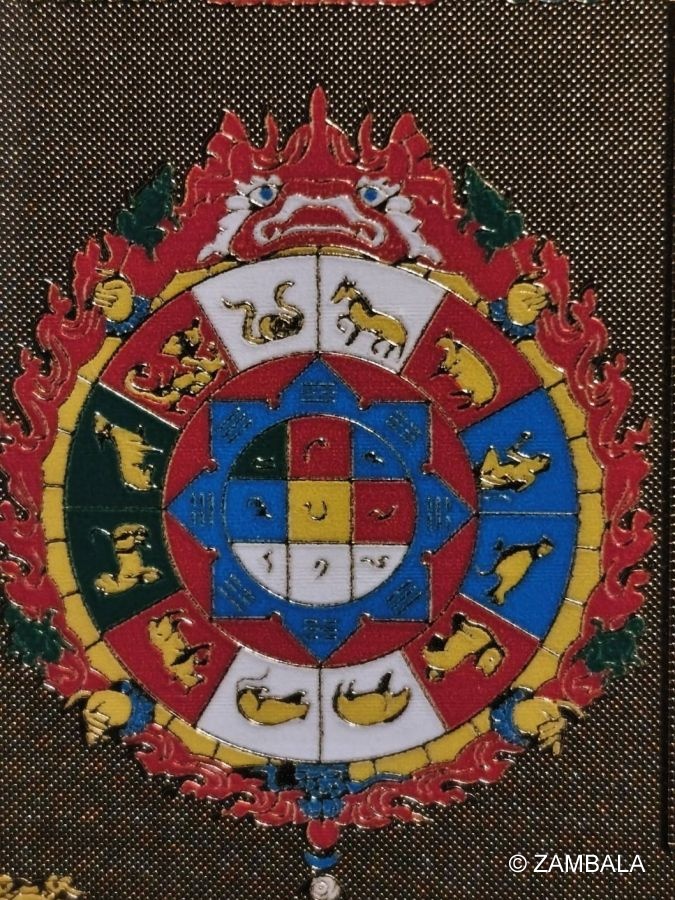
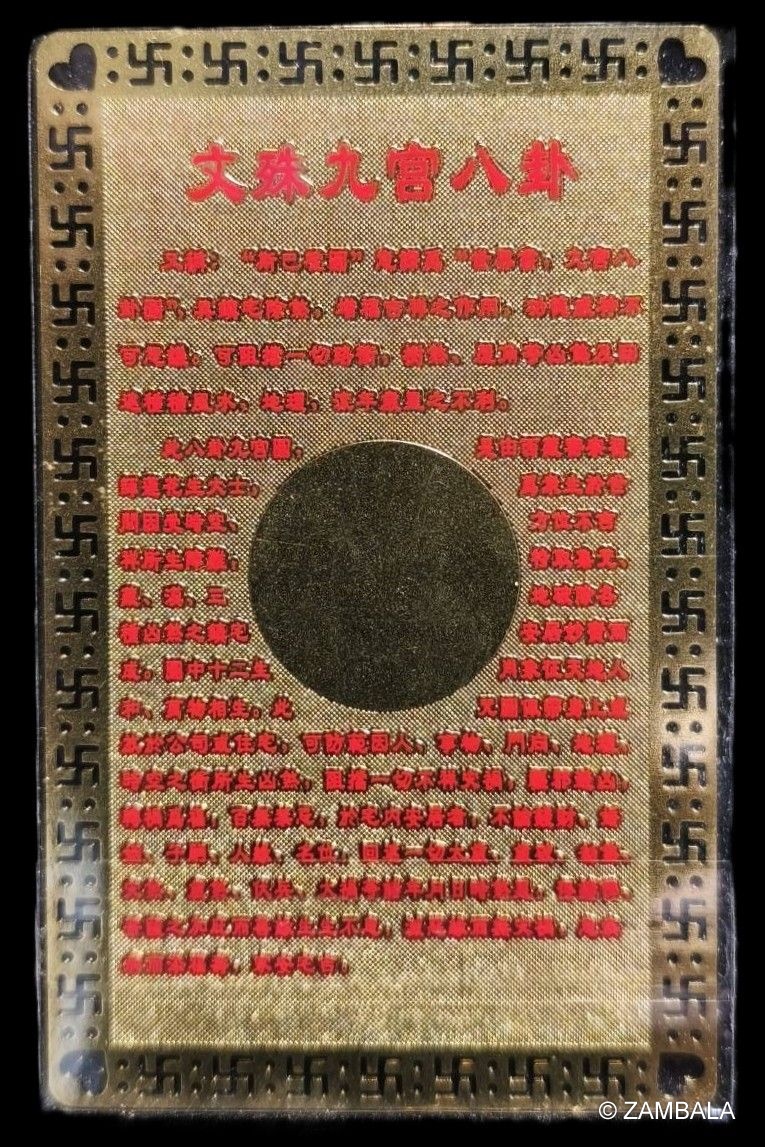
| Protection Mandala Sticker (S) |
|
|
|
| This Protection Mandala or Sid-pa-Khorlo gold card is 4x3inch. |
|
Sku#:0535-1
|
|
《In order to view the wholesale price .
Please Apply to be a wholesalers》
|
|
|
|
|
 |
|
Please contact us to verify availability. 1-626-354-6228
Email: zambalallc@gmail.com
America area customers can view on this website first.
https://FlyingMystics.org/ |
|
|
|
|
|
|
Material: Gold-plated, Buddha image, hard alloy, protective film
Size: 5 x 8 cm
Description:
The "Manjushri Nine Palaces Eight Trigrams" (or "Manjushri Bodhisattva Nine Palaces Eight Trigrams") is an extremely important homa ritual implement and blessed sacred object in Tibetan Buddhism (especially the Nyingma and some Gelug schools). It uses the wisdom power of Manjushri Bodhisattva as its principal deity, combining the traditional Han Chinese "Nine Palaces Eight Trigrams" (i.e., Luoshu, Later Heaven Eight Trigrams, and Nine Palaces Grid) with the esoteric practices of Tibetan Buddhism to create a ritual implement that can be worn or offered as a sacred object. Common forms include:
- A brass or silver nine-square grid (3x3 squares)
- A central Taiji symbol, with the eight trigrams corresponding to the eight directions
- Encased within are the Manjushri Bodhisattva mantra (Om Ah Ra Pa Tsa Na Dhīḥ), the seed syllables of the Five Dhyani Buddhas, and obstacle-removing mantras, etc.
- Often paired with five-colored threads (red, yellow, white, blue, and green) to form bracelets, necklaces, or car pendants.
This is not the Nine Palaces and Eight Trigrams of traditional Han Chinese Taoism, but rather a practice created since the Qing Dynasty by high-ranking Tibetan Buddhist monks (especially masters closely associated with the Qing court, such as the Changkya Khutuktu) to make the Manjushri wisdom blessings more accessible to Han Chinese believers. They "Sinicized" the Manjushri teachings of Tibetan Buddhism, thus possessing both the power of Tibetan Buddhist mantras and the form of the Nine Palaces numerology of Han Chinese culture.
Origin and Historical Transmission
1. **Source (17th-18th Centuries)**
- The most widely known figure is the Third Changkya Rinpoche (1717-1786), who was also the Imperial Preceptor of the Qianlong Emperor and the most important promoter of Tibetan Buddhism in mainland China.
- The Changkya Khutuktu was proficient in all the teachings of Manjushri Bodhisattva (especially White Manjushri, Yellow Manjushri, and Black Manjushri). To make it more accessible to Han Chinese, he combined the Tibetan Manjushri five-syllable mantra with the Later Heaven Bagua and Luoshu Nine Palaces of Han Buddhism, creating the "Manjushri Nine Palaces Bagua Plaque."
- The Qianlong Emperor was a devout believer in Manjushri Bodhisattva (considering himself an incarnation of Manjushri), and therefore vigorously promoted this ritual implement, even ordering its production and enshrinement at the Eight Outer Temples of Chengde and the Yonghe Temple.
2. **Subsequent Transmission**
- Later, successive Changkya Khutuktus, Aja Khutuktus, and lamas of the Yonghe Temple in Beijing continued to produce and consecrate it.
- In the 20th century, as many high-ranking Tibetan monks (such as the Venerable Gongga and the Venerable Qingxitai) propagated Buddhism in Han areas, they transmitted this teaching to their Han Chinese disciples.
- In modern times, the most well-known practitioners are probably the Venerable Rih-chih (a disciple of Nan Huai-chin) from Taiwan, many Living Buddhas of Kumbum Monastery in Qinghai, and some Nyingma lamas, who all perform this Manjushri Nine Palaces Eight Trigrams blessing.
Main Merits and Usage
Tibetan Buddhism believes this ritual implement combines the wisdom power of the "Manjushri Wisdom Sword" with the harmonizing power of the Five Elements of the "Eight Trigrams." Its main effects include:
1. Enhancing wisdom, improving exam luck, and achieving enlightenment (the power of Manjushri Bodhisattva)
2. Ward off evil spirits and obstacles, and resolving conflicts with malicious people (Eight Trigrams mirror and obstacle-removing mantra)
3. Preventing car accidents and ensuring safety (especially common when hung in a car)
4. Balancing the magnetic field and harmonizing Feng Shui (the concept of the Nine Palaces Flying Stars)
Common Usage:
- Wear it on your person (bracelet, necklace): Recite the Manjushri mantra 7 or 21 times daily, morning and evening.
- Place it on your desk or altar: Facing east or north (the direction of Manjushri Bodhisattva).
- Hang it in your car's rearview mirror: Can prevent accidents and bloodshed.
- Place it under your pillow: Helps to open wisdom and receive revelation in dreams.
- Before important exams, speeches, or negotiations, write "Om Ah Ra Pa Tsa Na" in cinnabar on a nine-square grid. The "Dhīḥ" is then wiped off, symbolizing the empowerment of wisdom (a common blessing method in Tantric Buddhism).
Impact on Buddhist Culture (especially the integration of Han and Tibetan Buddhism)
1. **A representative ritual object of the fusion of Tibetan and Han Buddhism**
- It is one of the few sacred objects accepted by both Tibetan and Han Buddhists, symbolizing the successful entry of Tibetan Buddhism into Han areas since the Qing Dynasty.
- Even many followers of Han Pure Land and Chan Buddhism wear it, regarding it as a "wisdom amulet."
2. **Making Manjushri Bodhisattva worship more accessible to Han people**
- While traditional Han areas also venerate Manjushri (Wutai Mountain), it was mostly limited to pilgrimage and worship.
- The emergence of the Nine Palaces and Eight Trigrams allowed ordinary people to "carry Manjushri's blessings with them," significantly lowering the barrier to entry for Tantric Buddhism and making it one of the most popular Manjushri practices.
3. **Modern Commercialization and Controversy**
- Now it can be bought everywhere online, but very few are truly blessed with lineage. Most are mass-produced in factories, consisting only of the Nine Palaces and Eight Trigrams outer shell, without the internal mantras, relics, or medicines of Tantric Buddhism.
In summary, the "Manjushri Nine Palaces and Eight Trigrams" is one of the most successful products of the fusion of Tibetan and Han Buddhist cultures since the Qing Dynasty. It packages the profound Manjushri Tantric practices into the familiar Nine Palaces and Eight Trigrams form, allowing the wisdom sword of Manjushri Bodhisattva to truly enter thousands of households, becoming the most widely known and portable wisdom homa ritual implement in the Chinese Buddhist community.
|
|
|
 |
|
|
|
|
|
|
|
|
|
|
|
|
|
|
|
|
© 2026 Zambala inc. All Rights Reserved. No part of this site may be reproduced without our written Permission.
Service Mail: ZambalaLLC@gmail.com
Phone: (626) 289-9787 or 1(888)Zambala (926-2252)
Fax: (626) 289-9719
1904 West Valley Blvd. Alahambra, CA 91803 USA
Unless stated otherwise in content's license. Design By
|
|
|