|
|
|
Wholesalers: |

|
/ |
|
|
|
|
|
|
|
|
| “A man is not called wise because he talks and talks again; but if he is peaceful, loving and fearless then he is in truth called wise.”
― Gautama Buddha, |
|
|
|
|
|
|
|
|
|
|
|
|
|
|
|
|
|
|
|
|
|
|
|
|
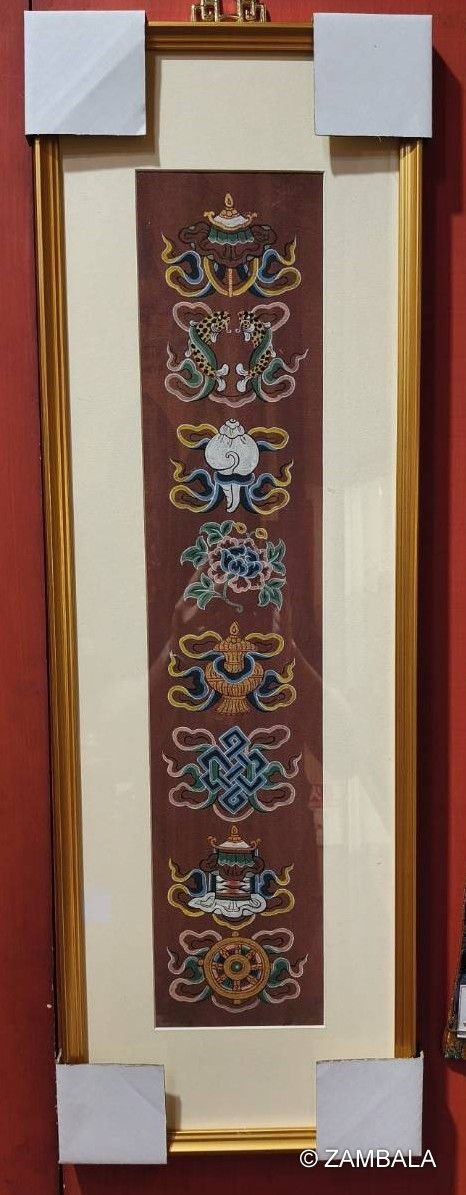
Sku#:536-8Auspicious B TYPE
|
|
|
Wholesale price |
US |
XXX.XX |
|
《In order to view the wholesale price .
Please Apply to be a wholesalers》
|
|
|
|
|
 |
|
Please contact us to verify availability. 1-626-354-6228
Email: zambalallc@gmail.com
America area customers can view on this website first.
https://FlyingMystics.org/ |
|
|
|
|
|
|
Material: Hand-painted Thangka, gilded aluminum frame, rigid cardstock
Size: 82 x 27 cm (including frame)
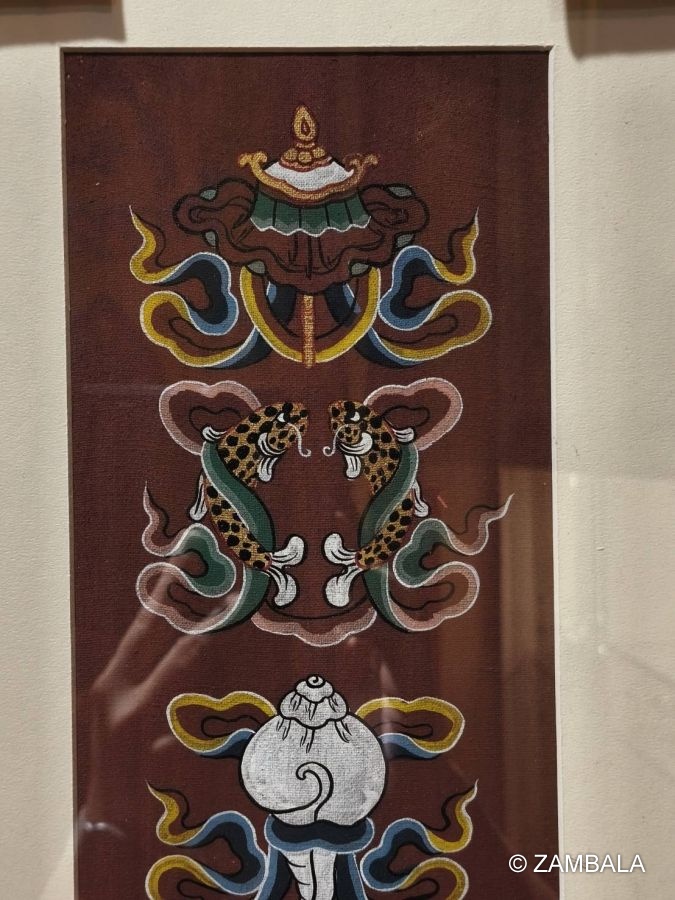
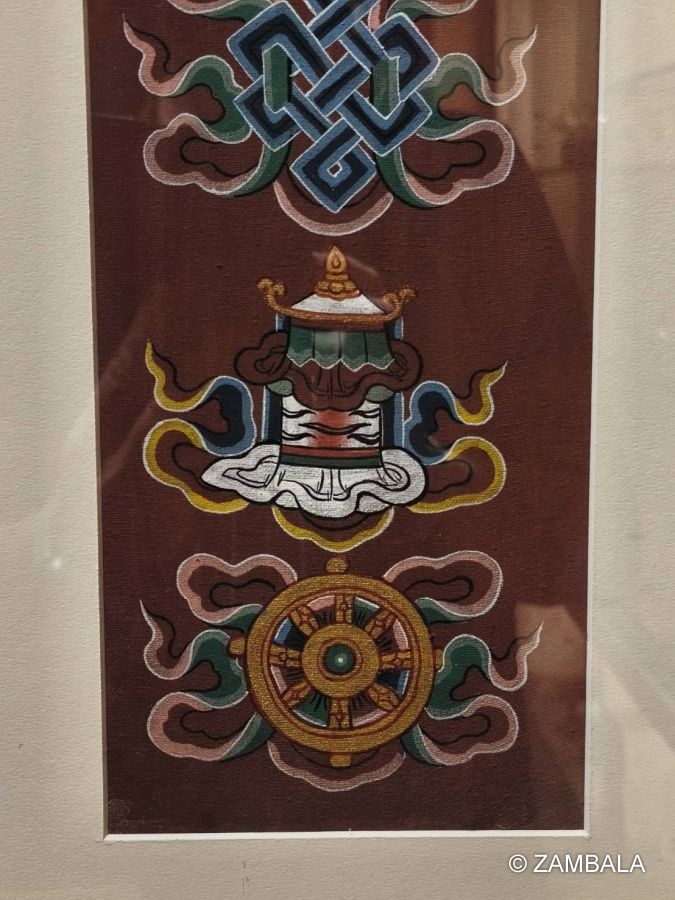
Description: The Eight Auspicious Symbols (Sanskrit: Ashtamangala, Tibetan: བཀྲ་ཤིས་རྟགས་བརྒྱད་, bkra shis rtags brgyad) are eight symbols in Buddhism representing auspiciousness, merit, and perfection. They often appear in sets on temple murals, Thangkas, offering vessels, ritual implements, architectural decorations, and even everyday items (such as curtains and flags). The eight symbols are:
1. **Chatra (Umbrella):** Symbolizes nobility and protection, shielding against the "heat" of afflictions.
2. **Suvarnamatsya (Golden Fish):** Symbolizes liberation and freedom, like a fish swimming freely in water.
3. **Kalasha (Vase):** Symbolizes abundant wealth and longevity, containing nectar.
4. **Padma (Lotus):** Symbolizes purity and enlightenment, rising above the mud unsullied.
5. **Shankha (Right-spiraling White Conch):** Symbolizes the Buddha's teachings spreading throughout the ten directions.
6. **Shrivatsa (Auspicious Knot):** Symbolizes dependent origination and eternity, without beginning or end.
7. **Dhvaja (Victory Banner):** Symbolizes the Dharma's victory over demonic obstacles, the banner of truth.
8. **Dharmachakra (Wheel of Dharma):** Symbolizes the Buddha's first turning of the Dharma wheel; the eight spokes represent the Eightfold Path.
> **Note:** Different schools (such as Theravada, Mahayana, and Tibetan Buddhism) may have slight differences in the details or arrangement of the images, but the core meaning remains the same.
II. Origin of the Story: From the Buddha's Time to the Formation of the Symbolic System
1. **Earliest Origin: The Buddha's Birth and the Seven Treasures**
- The prototype of the Eight Auspicious Symbols can be traced back to the auspicious signs at the **birth of Shakyamuni Buddha**. According to the *Buddha's Deeds Collection Sutra* and other records, when the Buddha was born, mandala flowers rained down from the sky, and seven treasures (including a parasol, a golden fish, etc.) appeared on the ground, symbolizing the supreme auspiciousness of the newborn prince.
- In ancient Indian royal culture, these items were originally the "Seven Treasures" symbol of the **Chakravartin**, representing the legitimacy and blessings of rule. Buddhism borrowed and transformed them into the "Eight Auspicious Symbols," emphasizing the perfection of the **spiritual kingdom**.
2. **Gradual Establishment in Buddhist Scriptures**
- In Mahayana scriptures such as the *Mahaparinirvana Sutra* and the *Lotus Sutra*, the Buddha often decorated the Dharma assembly with the "Eight Auspicious Symbols" during his sermons, symbolizing the completion of the Dharma assembly.
- The Tibetan Buddhist *Kalachakra Tantra* further correlates the Eight Auspicious Symbols with the cosmic mandala, regarding them as the auspicious foundation of the "Kalachakra" universe. 3. **Historical Dissemination and Visualization**
- **3rd Century BC:** During the reign of Emperor Ashoka, the Eight Auspicious Symbols were already carved on stone pillars (such as the Sanchi Stupa).
- **7th-8th Century AD:** With the eastward transmission of Tantric Buddhism, the Eight Auspicious Symbols became a standard feature of Thangka paintings.
- **From the Yuan Dynasty onwards:** Tibetan Buddhism influenced Han Chinese areas, and the Eight Auspicious Symbols were incorporated into Han Chinese temples (such as the Eight Treasures decorations in the Yonghe Temple in Beijing).
> **Interesting Anecdote:** Legend has it that when Manjushri Bodhisattva incarnated as a Tibetan painter, he personally painted Eight Auspicious Symbols Thangkas, teaching craftsmen that "every stroke contains Buddhist teachings," thus establishing them as a standard in Tibetan art.
III. Profound Influence on Buddhist Culture
| Direction | Specific Influence |
|------|----------|
| **Art and Architecture:** The Eight Auspicious Symbols are invariably depicted on temple lintels, shrines, and Thangka paintings; Tibetan stupas often feature the "Thirteen Heavens" (including the Victory Banner) atop their roofs. | | **Rituals and Offerings** | During Dharma assemblies, the Eight Auspicious Symbols (vases, conch shells, etc.) are offered to the Buddha; the Tibetan ritual of offering the "Eight Auspicious Objects" originates from this. | | **Folk Beliefs** | Han Chinese Spring Festival couplets often depict the Eight Auspicious Symbols, praying for "auspiciousness from all directions"; Tibetan families hang "Eight Auspicious Symbols flags." | | **Philosophical Symbolism** | The Eight Auspicious Symbols correspond to the "Eightfold Path" and the "Eight Consciousnesses," becoming objects of contemplation for practitioners. | | **Cross-Cultural Integration** | The national emblems of Nepal, Mongolia, and Bhutan all contain elements of the Eight Auspicious Symbols, becoming common symbols within the "Buddhist cultural sphere." |
IV. Modern Application Examples
- **Amulets**: Tibetan silversmiths imprint the Eight Auspicious Symbols inside gau boxes (amulet boxes) for protection and peace.
- **Architectural Feng Shui**: Han Chinese Buddhist temples often carve the Eight Auspicious Symbols on beams and pillars, symbolizing "the Buddha's light shining everywhere."
- **Digital Age:** The Eight Auspicious Symbols (such as the Dharma Wheel and the Lotus) are commonly seen in LINE stickers and Buddhist apps.
---
**Summary:** Originating as auspicious symbols of the Buddha's birth, the Eight Auspicious Symbols have evolved into the "auspicious code" of the Buddhist universe. They are not merely decorations, but also a **visual language of enlightenment**. They remind practitioners:
> "External auspiciousness (the Eight Treasures) reflects inner perfection (the Eightfold Path); afflictions are enlightenment, and the world is the Pure Land."
|
|
|
 |
|
|
|
|
|
|
|
|
|
|
|
|
|
|
|
|
© 2026 Zambala inc. All Rights Reserved. No part of this site may be reproduced without our written Permission.
Service Mail: ZambalaLLC@gmail.com
Phone: (626) 289-9787 or 1(888)Zambala (926-2252)
Fax: (626) 289-9719
1904 West Valley Blvd. Alahambra, CA 91803 USA
Unless stated otherwise in content's license. Design By
|
|
|