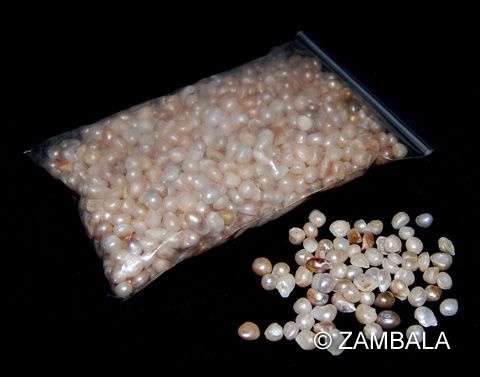
Material: Pearl shell, crushed pearls
Size: 1000 grams
Description: Pearls are considered one of the "Seven Treasures" in Buddhist culture, holding a very high status, alongside gold, lapis lazuli, agate, coral, amber, and giant clam shell, symbolizing purity, wisdom, and blessings. The following is a complete explanation from composition and formation to its application in Buddhist culture:
I. Composition and Formation of Pearls
- **Main Chemical Components**:
Approximately 95% of pearls are **calcium carbonate (CaCO₃)**, existing in the form of aragonite crystals. The remaining 5% is:
- **Conchiolin**: An organic protein, similar to keratin, secreted by the mantle of mollusks.
- **Moisture** (approx. 2-4%)
- Trace elements (magnesium, strontium, copper, zinc, etc.) and pigments (porphyrins)
- **Formation Mechanism**:
When a foreign object (such as sand or parasite) enters the shell, the pearl oyster (mainly Pinctada martensii, Pinctada penguin, and Pinctada salina, etc.) secretes nacre to coat the foreign object layer by layer, forming a pearl over 2-5 years.
→ Natural pearls are extremely rare (a probability of 0.03%), and have therefore been regarded as "the essence of heaven and earth" since ancient times.
- **Physical Properties**:
Mohs hardness 2.5-4.5, refractive index 1.52-1.69, possesses a warm pearlescent luster, and colors range from white, pink, and purple to black and gold.
II. The Important Position and Application of Pearls in Buddhist Culture
1. **First of the Seven Treasures, Symbolizing the "Wish-Fulfilling Jewel"**
- Buddhist scriptures such as the *Amitabha Sutra*, *Lotus Sutra*, and *Infinite Life Sutra* repeatedly mention the "Seven Treasures," with pearls often listed as the first.
- **Wish-Fulfilling Jewel (Cintamani):**
Legend has it that the jewel held by the Dragon King or the Cintamani Bodhisattva can "fulfill wishes and eliminate poverty," and its prototype is the pearl.
→ In Tibetan Buddhism, the **pearl** is one of the "Three Jewels" (alongside rubies and sapphires), representing "wish fulfillment."
2. **Offering and Decorating Buddha Statues**
- Since the Tang Dynasty, pearls have become the supreme treasure offered to the Buddha:
- The "Eight-Layered Treasure Box" unearthed from the underground palace of Famen Temple contains a relic of the Buddha's finger bone, its outer layer inlaid with thousands of freshwater pearls.
- In the murals of the Mogao Grottoes in Dunhuang, flying apsaras and offering bodhisattvas often wear pearl earrings and pearl beads.
- The Vajrabhairava statue in the Potala Palace, Tibet, always has a large pearl set in the center of its crown, called the "crown jewel."
3. **Rosary and Blessing**
- **Pearl Rosary**: Extremely precious in Tibetan and Han Buddhism, a 108-pearl rosary is priceless.
- Represents "108 kinds of purity," and reciting it can increase blessings and eliminate negative karma.
- Especially favored by practitioners of the Avalokiteshvara school, as Avalokiteshvara's vase is often depicted with pearls (symbolizing nectar).
- Pearls are believed to have a "calming and soothing" effect, consistent with the Buddhist practice of "concentration."
4. **Medical and Esoteric Buddhist Applications**
- The *Compendium of Materia Medica* records that pearls "calm the mind and spirit, detoxify and promote tissue regeneration." Esoteric Buddhism uses pearl powder to make "pearl powder," which is offered to the Three Jewels or used to treat eye diseases.
- In Tibetan medicine, the main ingredient of "Seventy-Flavor Pearl Pill" (Rinchen Ratna Samphel) is pearl, considered the "King of Sacred Medicines."
5. **Symbolic Meaning Summary**
| The Meaning of Pearls in Buddhism | Corresponding Symbols |
|---|---|
| Perfection and Flawlessness | Pure Buddha-nature |
| Gentle and Refined | Compassionate and Gentle |
| Beauty Arises from Suffering (Stimulation of the Shell) | Suffering, Origin, Cessation, and Path |
| Rarity and Preciousness | Impermanence and Value |
III. Pearl Culture in Taiwanese and Chinese Buddhism
- The four major Buddhist centers in Taiwan (such as Dharma Drum Mountain and Chung Tai Chan Monastery) often use pearl beads as consecrated amulets.
- The Mazu belief is also influenced by Buddhism, with pearls often offered as "Tianhou Pearls" (the crown of the Tianhou statue at the Meizhou Ancestral Temple is inlaid with 13 large Eastern pearls).
- Modern Taiwanese designers (such as Xinqi Jewelry) have launched Buddhist jewelry such as the "Guanyin Pearl Lotus Seat," combining fashion and faith.
In conclusion, the pearl's transformation from the painful act of a grain of sand into a flawless and lustrous treasure mirrors the core Buddhist doctrine that "afflictions are enlightenment." It is not merely a material treasure, but also a spiritual sustenance—
**"One pearl reflects immeasurable light."**